
 Search


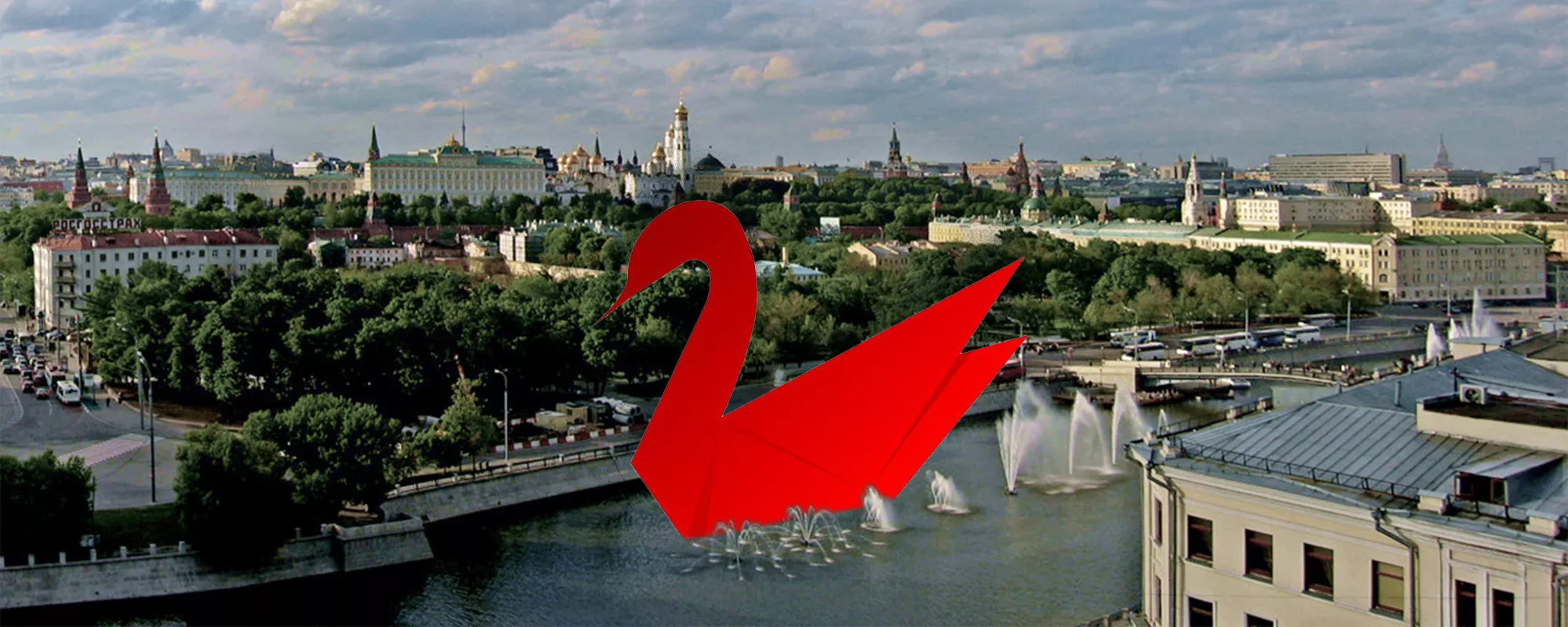
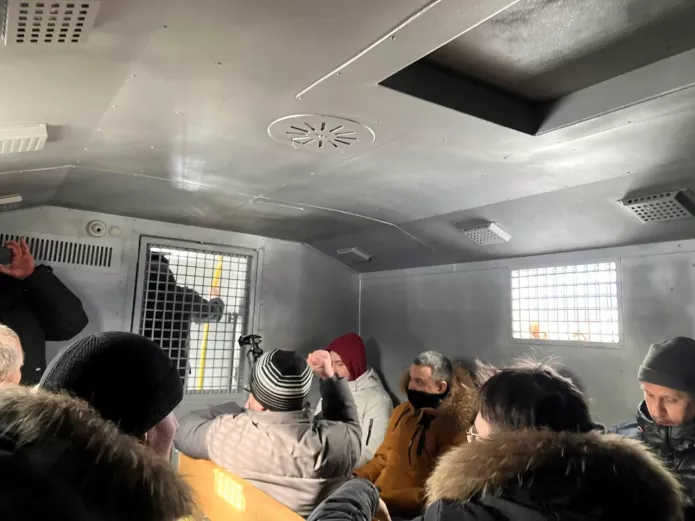
Mass protests against the Telegram ban, announced for March 29 by the “Alyi Lebed” (“Scarlet Swan”) movement and political strategist Dmitry Kisiev, basically never took place. Authorities rejected all 28 protest requests under various pretexts. Still, in some cities, small groups of people showed up at the planned locations. 27 people were detained. In Moscow, two people were beaten while in police custody.
NO ONE WILL EVER KNOW
Unless someone writes about it. OVD-Info is often the sole source for news on repression, while also providing legal aid to political prisoners. We depend entirely on your support to continue. Join our recurring donors to keep these stories—and people—from being forgotten.
In the winter of 2026, Russian authorities redoubled their efforts to block Telegram and restrict internet access. Citing ongoing drone attacks, “whitelists” were introduced across the country, limiting access to a predefined set of websites and services. In central Moscow, mobile internet was unavailable for three weeks. In several regions, disruptions have lasted for months.
In February, the outlet The Bell reported that Telegram could be fully blocked in the country starting April 1. On one hand, the platform is an important space for independent media, human rights groups, and political projects. On the other hand, Telegram has also become home to extensive networks of pro-government and pro-war bloggers with large audiences. At the same time, even representatives of the Russian authorities appear to have little trust in the domestic messaging app “Max,” which the state has been actively pushing in recent months.
A potential Telegram ban could affect people on both sides of the political divide. According to Novaya Gazeta, pro-government media lost 23% of their audience amid the initial slowdowns, while opposition outlets saw a 10% decline. Ivan Filippov, author of the Telegram channel “Na Zzzzzapadnom fronte bez peremen” (“All quiet on the Western front”), shared statements from military personnel and pro-war “Z-channels” who spoke out strongly against the restrictions, citing the platform’s importance for the front.
“People are tired of you, your arbitrariness, and your abuse of power,” wrote Sevastopol-based propagandist and nationalist Vsevolod Radchenko after receiving a warning from security forces against participating in the protests, according to ASTRA.
Various political groups attempted to organize protests against the Telegram ban as early as February and early March, in at least eleven cities. Applications were submitted by representatives of the Yabloko party and the Communist Party (СPRF). The Syktyvkar (February 20) and Naryan-Mar (February 28) rallies were approved and took place without detentions; in both cases, the organizers were members of the Communist Party.
On March 1, activists in Novosibirsk attempted to hold a rally in defense of Telegram in a local “Hyde Park” area, where no prior approval is required by law. However, city authorities still banned the event, citing tree pruning as the reason. The area was fenced off, access was blocked, and participants were detained. They were later released without being charged.
On March 30, reports said that the organizer of the protest that never took place was fined 250,000 rubles. A court found Sergey Krupenko guilty of a repeat violation of the rules governing public assemblies.
On February 12, members of the National Bolshevik movement held a protest in Moscow under the slogan “Give us an internet without surveillance—a Russia without Roskompozor” (play on the Russian word ‘pozor’ meaning ‘disgrace’ and the federal agency’s title). Three people were detained.
In nine other cities where activists filed for protest permits against the restrictions, authorities banned the events, citing streets not having been cleaned from snow, COVID-19 restrictions, and the “absence of any blocking or repression in the country.” In Barnaul, the city administration refused to approve a rally, stating that the wording “against political repression” used in the application “does not correspond to reality,” while the phrase “against the blocking of popular internet resources,” according to officials, “does not reflect the actual situation.”
What is the “Alyi Lebed” movement?
In mid-March, TikTok was flooded with videos containing euphemistic calls to protest. Some of them were generated using AI. The outlet “Agentstvo” identified more than 50 such videos. In them, Russians were encouraged to go out into the streets of their cities on March 29 to take “free photos,” or to look for a cat, a dog, or a lost wallet. The videos identified by “Agentstvo” received between 100 and 60,000 views.
Some of the videos featured the logo of a previously unknown group called “Alyi Lebed” (“Scarlet Swan”). Others included links to a Telegram channel with the same name (initially titled “Alyi Lebed Rally 29.03,” later shortened to “Alyi Lebed”)
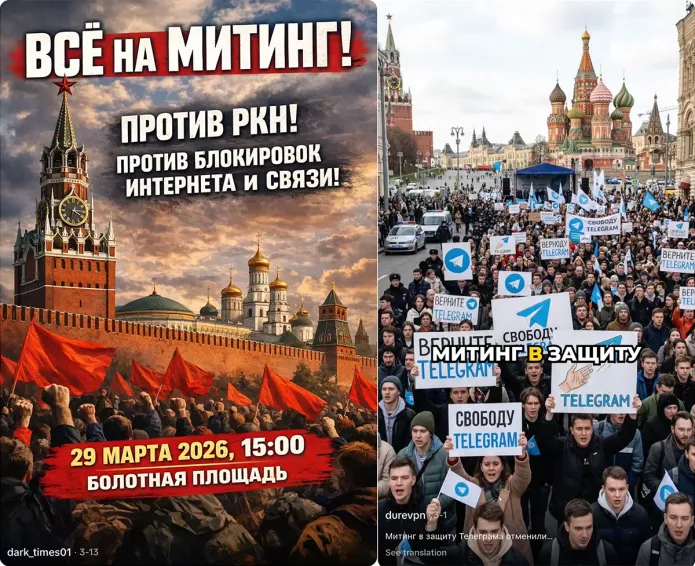
Dmitry Kisiev, former head of the campaign staff of would-be presidential candidate Boris Nadezhdin, announced protests against internet restrictions for the same date. According to him, the choice of the 29th was chosen as a reference to the article of the Constitution concerning freedom of speech and the prohibition of censorship.
Kisiev, who was stripped of his acquired citizenship (Kisiev is a Crimea resident who received citizenship automatically after the peninsula’s annexation), is not currently in Russia. He said he knows nothing about the “Alyi Lebed” (“Scarlet Swan”) events and is not connected to the movement in any way.
The Telegram chat “Protest 29.03” was started on March 13. The “Alyi Lebed” (“Scarlet Swan”) Telegram channel—on March 15, the day after Kisiev’s announcement. The channel and chat quickly gained thousands of participants.
According to Verstka, the organizers included young people with diverse political views and no clear political experience. Verstka also shared the story of one organizer who “is not yet 20 years old and, judging by his subscriptions, holds opposition and libertarian views.” He told the outlet that he came up with the name “Alyi Lebed” (“Scarlet Swan”) as a “symbol of the fight for freedom.”
The young man claimed that he received threatening calls and messages, and that before leaving the project, under pressure, he posted a picture of one of the permit applications in the chat containing personal data of other organizers. They have also received threats after that.
Police came to the administrator of the Moscow chat, 19-year-old Sofia Chepik: she was taken from her home for a “precautionary conversation” and released with a “warning about the inadmissibility of breaking the law.”
Due to contradictory statements and abundance of AI-generated content, as well as lack of clear information about the organizers, the “Alyi Lebed” (“Scarlet Swan”) movement awoke distrust. Journalists supposed that the project might be a provocation (this was not directly confirmed).
Now and again there were messages in the chat calling for violence or containing Molotov cocktail recipes. Those were later deleted, and the organizers stated they did not support such ideas.
On March 23, the “Alyi Lebed” (“Scarlet Swan”) Telegram channel reported that one of its administrators sold their account in the messenger to representatives of the founder of “Men’s State” Vladislav Pozdnyakov. “Novaya Gazeta Europe” wrote on the same day that the channel was hacked. Soon after representatives of the movement reported a split—allegedly part of the organizers, including Chepik, began creating clones of the project.
The organizers told “Agency” that they were in talks with Dmitry Kisiev and that he had supposedly “picked up their idea” for the rallies. In Kisiev’s view, “Alyi Ledeb” is not connected to the FSB: “Law enforcement agencies are not smart enough to carry out such schemes. Rather, this points to spontaneity and lack of structure—they are only just starting out and learning on the go.”
“Not allowed because of COVID.” How March 29 actions were banned
Dmitry Kisiev’s headquarters submitted applications for “large-scale rallies against internet and communications blocks” in 28 cities of the country.
Surprisingly, in five cities—Krasnodar, Yakutsk, Vladimir, Murom and Penza—the authorities initially approved the rallies. However, closer to the scheduled dates, all permits were revoked, and the Ministry of Internal Affairs urged “not to react to provocative statements by organizers of unsanctioned public events.” This statement was broadcast on the air of one of the federal channels.
Five of the people who submitted permit applications for the Moscow rally were arrested for 15 days two days before March 29. They were charged with “disobeying the lawful order of a police officer.” Two more “Alyi Lebed” (“Scarlet Swan”) participants left Russia.
The day before the rally in Tomsk, one of the organizers, Anton Isakov, whose permit application was denied, was detained on suspicion of petty hooliganism. The head of the public safety committee of the mayor’s office, Sergei Sladkin, stated that all 15 proposed sites were occupied, Roskomnadzor’s actions were lawful, and statements about internet restrictions can be regarded as “fakes.” On March 26, Isakov was summoned to the police station, where he received a warning about the inadmissibility of unsanctioned protests and a call-up paper to the military draft office to “clarify data.”
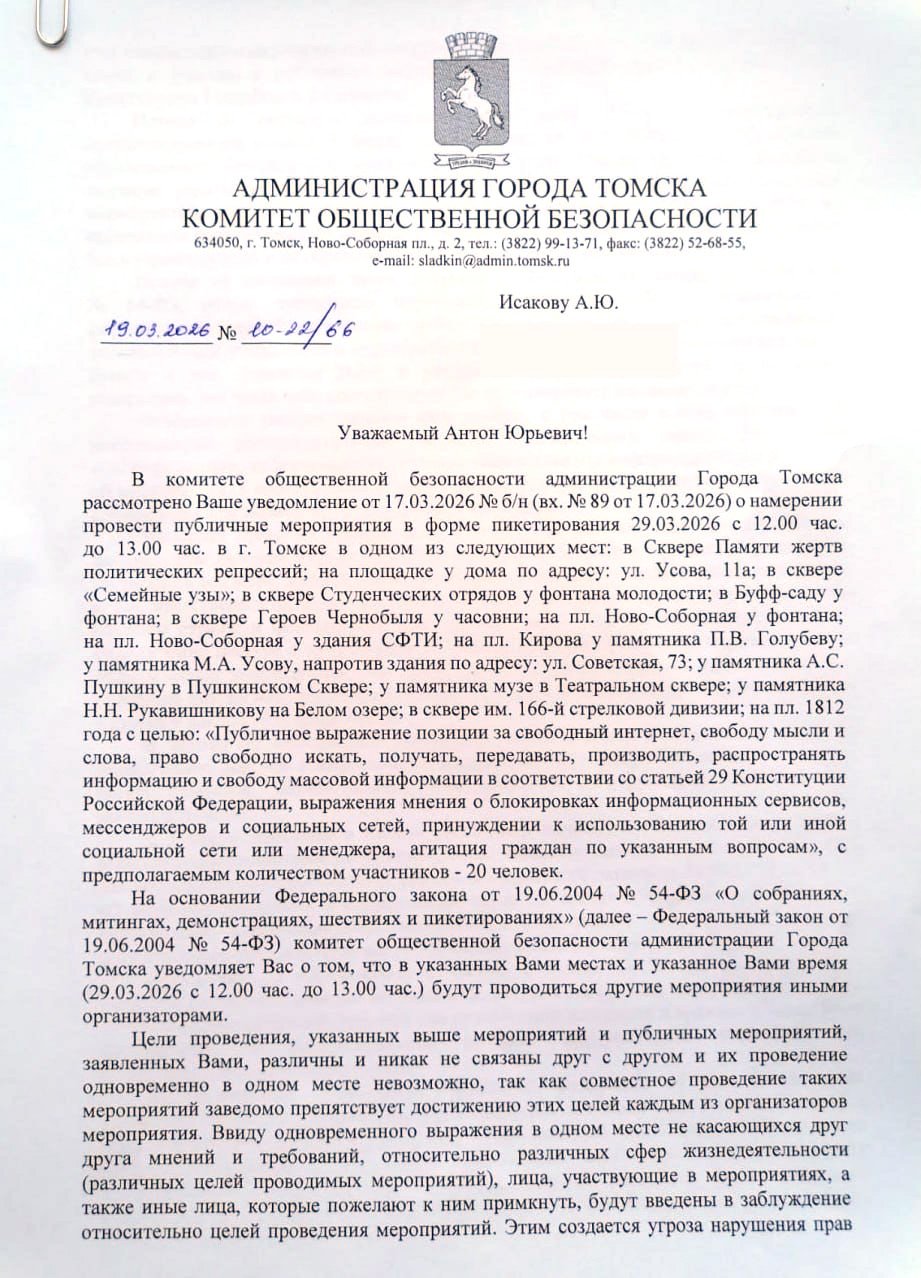
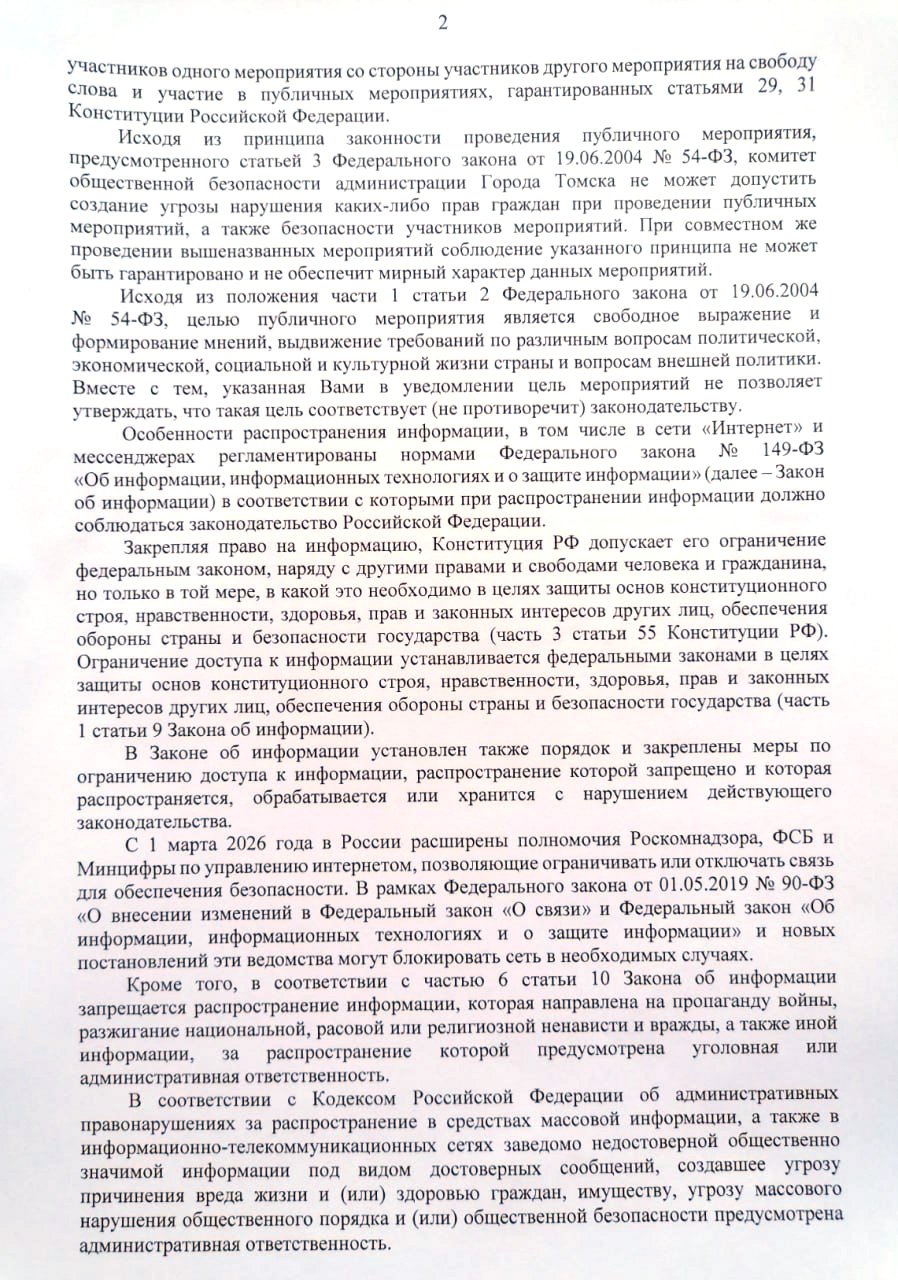
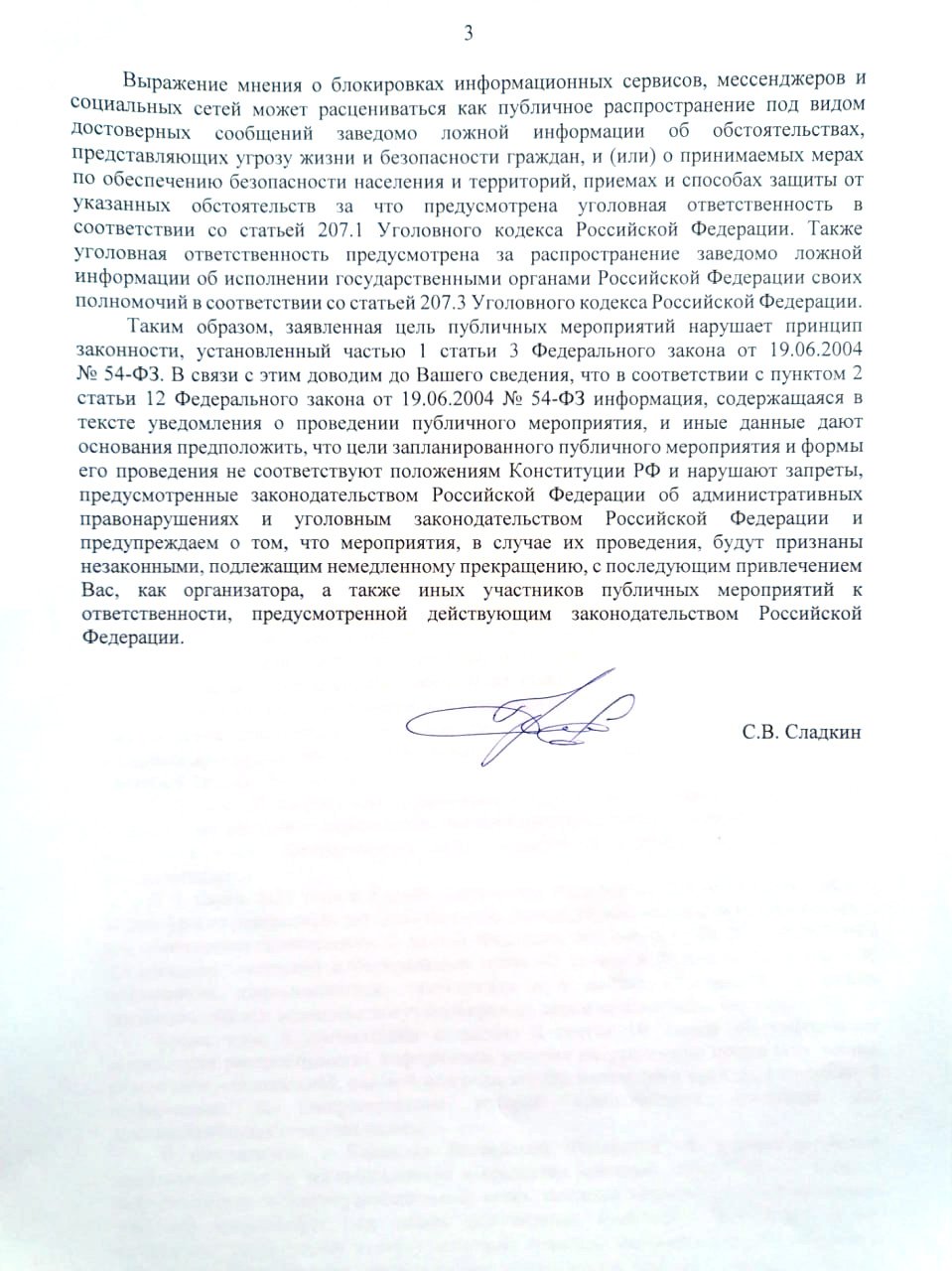
Scans of the official refusal from the Tomsk authorities / Source: Telegram channel of Anton Isakov, candidate for deputy of the Tomsk Regional Duma
Aleksei Popov from Yakutsk, who submitted an application to hold a rally, was detained on March 28. Varvara Luch, an organizer from Volzhsky, a city in southwestern Russia, canceled the action after a warning about the inadmissibility of extremism. In March, she was suspended from work after security services visited her workplace and threatened management with fines and criminal prosecution.
Authorities in greater Moscow cities denied rally permits to supporters of politician Boris Nadezhdin due to “coronavirus restrictions.”
In Penza, a protest planned by the movement “For a Free Internet” at the entrance to the Komsomolsky park was initially approved by the authorities. However, on March 27, the officials suddenly announced that a public roller-skating event would be held at the location on March 29. The protest had to be cancelled. On that day, the Telegram channel of the movement posted a photo of a young man picketing, with the caption: “There never were any roller-skating workshops and there won’t be. Police are still aimlessly circling the area.”
According to an anonymous OVD-Info analyst, the pressure on the protest organizers may be related to the authorities’ hostility towards any grassroot groups: “The authorities never liked that. Even before the war started we clearly saw that the government blocked and outlawed any grassroots organizations. Think of the protests against the abolition of the local government bodies in the Altai Republic. When a semblance of an organization began forming there, they opened a criminal case against it.”
Preventive arrests of protest organizers are not a new practice. “For many years, this has been a typical occurrence leading up to large protests: well-known city activists would be detained even before the start of the event just to remove them from the streets. Even those who did nothing but write or repost on social media about the unsanctioned protest were treated the same—they were considered organizers and detained for it,” concludes the analyst.
How the Protests Unfolded
On March 29, a few dozen people, mainly teenagers, gathered on Bolotnaya Square in Moscow, where the protest was not approved due to “COVID restrictions.” Both regular and riot police (OMON) were deployed there. Mobile data signal was jammed around the square. Police pushed people out into the nearby streets, urging them to leave.
17 people were detained, including a person with a “No to War” sign and human rights defender Alexander Podrabinek, who was photographing the gathering. Attorneys were not allowed to enter police stations where the detainees were taken.
One of the detained, Artur Vagner, who lives with a disability, shared that, at the Meshchansky police station, officers beat him on the back of the head and threatened to beat him again on camera. Moreover, he claimed that his bank card was stolen at the police station. Artur’s aunt, Ekaterina, was detained along with him—the officers pressured him to say that she was the one who coerced Artur to come to the protest. Artur was then released, but Ekaterina was kept at the station overnight.
Another detainee, Vladislav Azarochkin, reported being beaten by several officers at the Yakimanka district police station. One of them was in plainclothes. Azarochkin was threatened with torture and sexual violence.
“He told me he was insulted and beaten on the way to the police department. There are bruises on his face, his leg is swollen, and an ambulance treated him and gave him an injection but refused to hospitalize him,” said his lawyer, Oscar Cherdzhiev. “He says he is still feeling unwell, and that he gave no grounds for the use of force against him.”
He was charged with petty hooliganism (Article 20.1 of the Code of Administrative Offences) against Azarochkin. He was kept at the police station overnight.
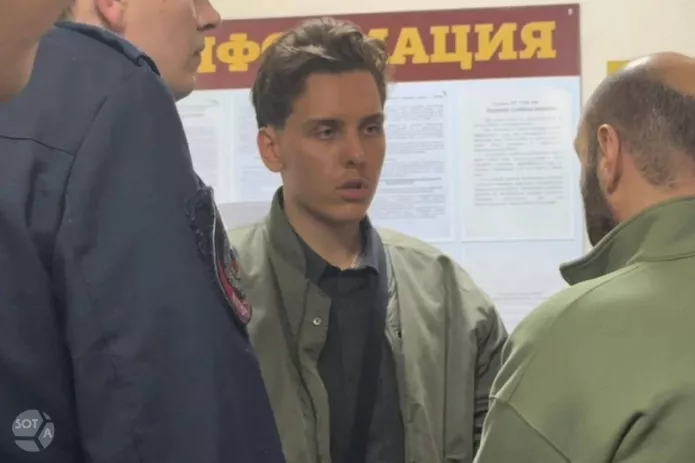
On March 29, dozens of officers were patrolling the central squares of various Russian cities. In Ekaterinburg and Murmansk, the ultra-right Russian Community’s vigilantes joined police in monitoring passersby. In Murmansk region internet was jammed in anticipation of protests against internet blockages.
In Saint Petersburg police detained two people. In Voronezh police removed the activist Nikita Nesmeyanov from the town square. He was picketing with a libertarian flag and a sign reading “Stop slowing us down. Stop blocking us. For free internet!!! Against censorship!!!”
On March 30, Moscow courts sentenced six participants of the protest on Bolotnaya square to 15 days of administrative arrest.
Already on March 29, Dmitry Kisiev called for new protests against internet restrictions on April 12, which falls on both Cosmonautics Day and Easter.
“We went from space exploration to ‘whitelists’: in Moscow, even public restrooms did not work without internet access, and in the regions, people were forced to communicate through e-mail like in the 90’s instead of modern messaging apps used by the rest of the world <…> Despite not getting protests sanctioned in more than 40 cities, we will keep fighting and push for these permits,” wrote the political strategist.
Marina-Maya Govzman
NO ONE WILL EVER KNOW
Unless someone writes about it. OVD-Info is often the sole source for news on repression, while also providing legal aid to political prisoners. We depend entirely on your support to continue. Join our recurring donors to keep these stories—and people—from being forgotten.