
 Search


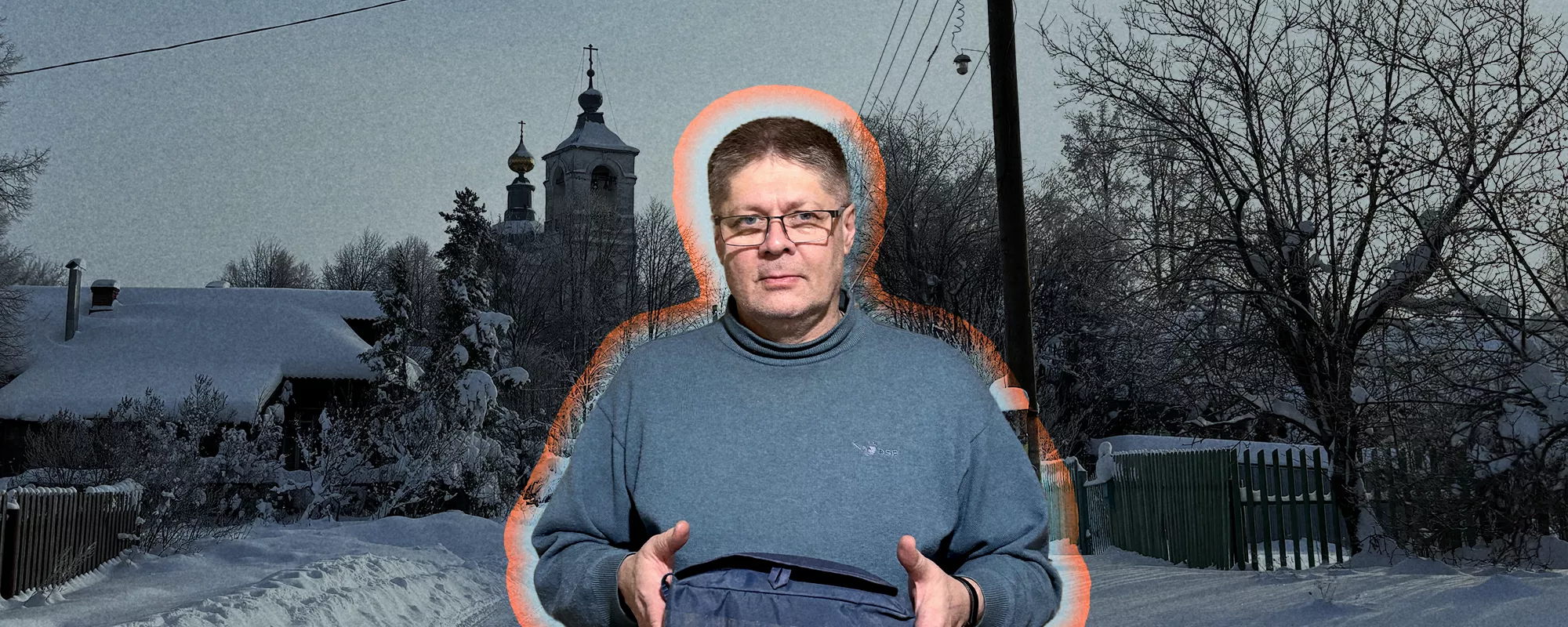
In 2022 a criminal case was opened against Gregory Winter for antiwar posts on social media. In 2024 he was sentenced to three years in a penal colony. Before his imprisonment, the social activist from Cherepovets was nursing street animals back to health, 12 cats were living in his flat. Winter continued to help animals in the colony. When he was released, Gregory set off to a remote village in Ivanovo region, to meet Father Alexandr, who was supporting him during his imprisonment. Father Alexander previously worked as a priest in penal colonies and pre-trial detention centres. An OVD-Info correspondent has joined Gregory on his journey.
NO ONE WILL EVER KNOW
Unless someone writes about it. OVD-Info is often the sole source for news on repression, while also providing legal aid to political prisoners. We depend entirely on your support to continue. Join our recurring donors to keep these stories—and people—from being forgotten.
Gregor Marcus Severenin Winter left the penal colony № 5 in Kirov region on the morning of December 30th. He spent two years and one month in detention.
Gregory brought a bag from the colony out with him containing 18 kilos of letters from strangers from all over the world. The bag was weighed at the post office, when he was sending it from Kirov to his home in Cherepovets. Ahead of his release, he asked in all of his letters for people to meet him on the outside and help with his bags, but nobody came to the colony gates.
Winter said that after his release he went to help the men who were released on the same day, they got drunk and were almost late for the train to Moscow. On the 31st of December he went to get the cats, who were waiting for him at various pet sittings, and before that were living in the penal colony. The prisoners didn’t want to let the cats into the barracks, so Gregory came up with a scheme: he “packed” the cats into a cardboard box and taped it shut so they wouldn’t escape. A prisoner who was about to be released would notify the prison officers that he is not leaving alone, and would take the cats with him—at the gates they would be handed to a volunteer. The prisoners almost never refused, but the majority asked for money.
“The prison administration never asked any questions. The person who is ‘going for a call’ has the right to take anything that is not considered an institution’s property with them. Cats are not an institution’s property. You could take 5 or 10 out—no one would bat an eye.
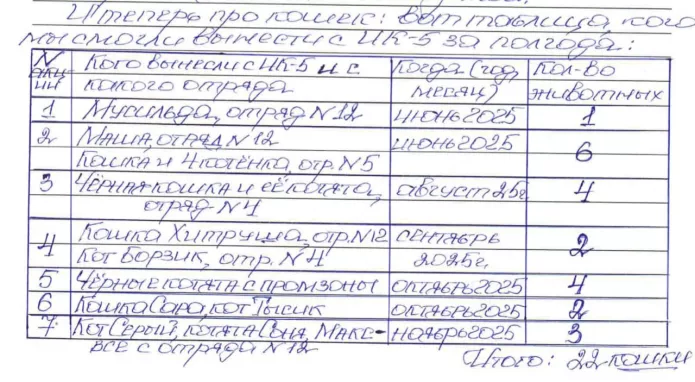
In the colony he kept a table with the names of all the rescued animals: cat Borzik, Hitroushka, “kittens from industrial zone” and others—22 animals in total. The majority found their home in shelters, but 4 cats have waited for Winter to get out of the colony. After his release he brought them to a rented flat, let them roam and went for a walk around Kirov.
“The city was weird,—Winter remembers,—people were walking around with such harsh faces, as if their mum had died yesterday.”
He bought himself a celebratory dinner—salad, kefir, and champagne in a can. The one-room flat that he rented didn’t have a table, so Gregory made one from a stool. He turned the TV on, watched the president’s address and went to bed soon after that—“prisoner’s habit” of going to sleep early. The cats climbed on top of him, and he closed his eyes.
“It’s a lot harder coming out of prison, than going in”
“It’s a lot harder coming out of prison, than going in”—says Winter. “I don’t have any money. Do you know how much they offered me at the social aid office in Cherepovets after my release from the colony? They said that it’s ‘help, so you can have something to live on’—3 thousand rubles.”
Gregory Winter is 57. We are meeting him in Moscow to go together to the priest who was his correspondent in the colony—Father Alexandr. Winter’s hair is cut short, he’s wearing simple black trousers and a gray T-shirt. He has a small flip phone and a blue pouch with medications, insulin and pulse monitor. There’s a rectangular charm with his initials on the pouch—a relic from the colony, where any property of the incarcerated is marked, you can’t have anything extra. Gregory’s hands are covered in small cat scratches.
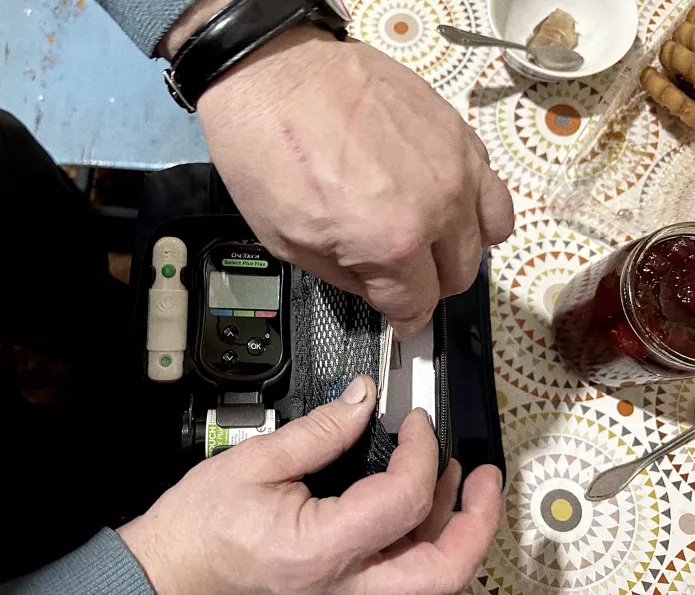
In his home city Cherepovets, Winter has no one left, with whom he’d still be in contact. He hasn’t talked to his older brother, who lives in St. Petersburg, for over 15 years. In 2021, one of Gregory’s loved ones died from an overdose. Winter received the news of her death in the hospital—he was seriously ill with COVID, as a result he now has second type diabetes.
Before his arrest Winter was known as an activist from Cherepovets, and a former head of the local office of the Human rights movement. In 2019 Gregory, at that time Grigory, was accused of offending a former mayor of Cherepovets Elena Avdeeva and current head of the city Margarita Guseva in his post on the social media platform, VK (article 319 of Criminal Code). He was sentenced to 280 hours of community service.
That same year, Winter was ordered to undergo a mandatory psychiatric evaluation as part of another criminal case—this one involving threats made against a court secretary. According to Mediazona, this case was opened in October 2018 under the statute covering threats of death or bodily harm (Article 119 of the Criminal Code). According to investigators, Winter had threatened to blow up the courthouse with a grenade.
Another criminal case was opened in 2020 under the statute prohibiting the “dissemination of knowingly false information” regarding the coronavirus (Article 207.1 of the Criminal Code). At the height of the pandemic, Winter wrote that inmates were being transferred to a pre-trial detention center in Cherepovets in violation of sanitary and epidemiological protocols. During the proceedings, a charge of “insulting a government official” (Article 319) was added, stemming from alleged profanity used during a search of his home. Later, further charges were brought for contempt of court and insulting trial participants (Parts 1 and 2 of Article 297).
Winter subsequently spent a month in pre-trial detention after the court tightened his restrictive measures, citing his failure to attend hearings. Winter maintained that he was on medical leave at the time and had notified the court accordingly. On his very first night in detention, Winter was beaten. “My jeans were wet with blood; the pant leg was soaked through,” he told OVD-Info. “Of course, I was very vocal in court. I called the judge something he thought was very insulting.”
A month later, a regional court ruled the detention order illegal, and Gregory was released. A forensic medical examination later revealed a scar from a recent injury on his left leg (a copy of the report is held by OVD-Info). The Vologda Branch of the Federal Penitentiary Service (FSIN) dismissed the reports of violence as “factually incorrect.”
On April 13, 2022, Winter was sentenced to 380 hours of community service under Articles 207.1 and 319 of the Criminal Code. Upon appeal, the Vologda Regional Court overturned this ruling, and the Cherepovets Court subsequently reduced the sentence to 320 hours.
In August 2022, Winter was arrested again—this time on charges of “spreading false information” about the military. The case was based on his posts about the strike on the Mariupol Drama Theater and a comment referencing statements from Ukrainian human rights activists about children sexually abused by Russian soldiers. Nearly two months later, Gregory was transferred from pre-trial detention to house arrest, and placed under a measure restricting certain actions.
After spending nearly a year under house arrest, Winter became convinced that the case would result in a prison sentence. He began searching for new homes for his cats—he had twelve of them at the time.
“I have a severe form of diabetes and, if I am sent to prison, I won’t make it out alive because there are no medications there; so I still have to settle the fate of my cats,” Gregory told the outlet Novaya Vkladka. A full-scale rehoming campaign followed that ended successfully: all of the cats were placed in new homes.
On the eve of his sentencing, Winter wrote an appeal to Russian President Vladimir Putin, requesting euthanasia should he be given a prison sentence. While he was in a pre-trial detention center, human rights activists reported that Gregory wasn’t receiving insulin and other vital medications. The Memorial launched a fundraiser for his daily medical supplies. Once transferred to a penal colony, Winter began receiving insulin from volunteers.
The prosecution initially sought a sentence of six years and three months in a penal colony. The final sentence handed down was half that length.
“We fought, we gathered character references,” Winter says. “If you scream in court that you won’t renounce your convictions, no one is going to reduce your sentence in the current climate. But if you provide papers showing that you are a valuable member of society, there’s a chance you’ll get a shorter sentence. Every single day counts in there.”
The village of Strelka and the Priest
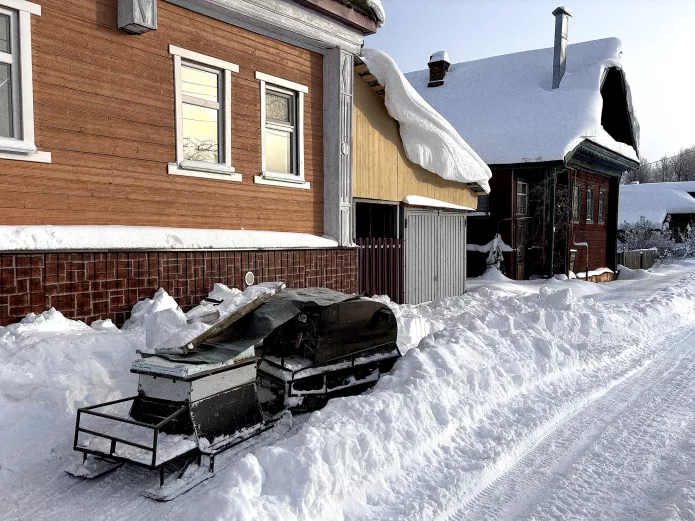
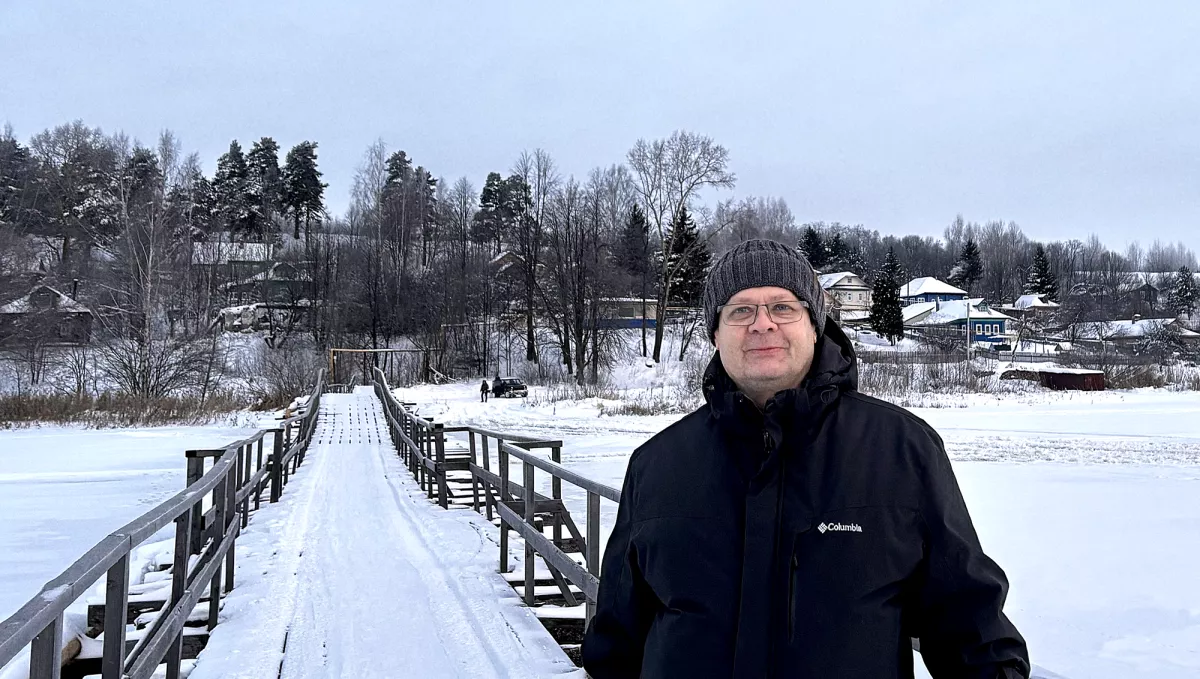
It is impossible to plot a route on Google Maps to the village of Strelka in the Ivanovo Oblast, where Father Alexander lives—the “maps” simply don’t see it. Strelka sits right on the banks of the Volga. At one time, riverboats used to run here, connecting coastal villages with the big cities. There hasn’t been any river transport in this area for a long time.
In Tatyana’s home, where we are staying, there are woven sleds—the locals use them to go shopping in neighboring Kamenka, about a forty-minute walk away. In Strelka itself, there are no shops and no medical post. For medical help, people also go to Kamenka. The village is quiet and snowy. Most of the wooden cabins are shuttered and empty until summer. Those left behind are mostly pensioners who live in Strelka year-round.
Father Alexander and Gregory first met when the priest wrote him a letter. At the time, Winter had been transferred to Strict Conditions of Confinement (SUS)—and he now says that Father Alexander’s letters were the most sincere and poignant of all: “they weren’t filled with bureaucratic clichés, but with words written from the heart.”
I follow [priest] Andrei Kordochkin. He once put out a call saying that anyone who wants to correspond with political prisoners should message him privately,” Father Alexander recalls. I wrote to him. About twenty priests are involved in this now. Gregory was my first correspondent; now there are more than ten such people: some are in pre-trial detention centers in Moscow, some in St. Petersburg, some in Yekaterinburg. One young man, Bogdan Davydenko, is being held in Khabarovsk Krai.”
After praying, he invites us to the table for tea and coffee, cocoa-banana dessert, and cottage cheese pastries. They were baked by Tatyana, the priest’s neighbor. She worked as a cook all her life; seven years ago, she returned to her childhood home to care for her parents, and stayed there after they passed away.
The snow-covered Volga is seen from the window of the priest’s house. Father Alexander’s wife, Nadezhda—a slight, reserved woman—quietly slips into the next room for the duration of the talk. Listening to Father Alexander, I remained for a long time under the impression that he himself had experienced imprisonment—Gregory had said that he “had been a dissident and had served time in Soviet prison camps.” But it turns out the reason for his familiarity with the prison system is more prosaic: he was never imprisoned himself, but served as a priest in penal colonies and pretrial detention centers.
Father Alexander speaks knowledgeably about prison hierarchy—the differences between “black” and “red” colonies, and where and why it is easier to serve time. He recounts how prisoners’ relatives organized protests against the administration of the penal colony where he served as a priest. Then, in his words, “some higher powers” stepped in: a criminal case was opened, the leadership was ousted, and some were forced into retirement.
Then Father Alexander—Alexander Izrailevich Sobol—shows us yellowed booklets: the birth certificates of his relatives. The names in them—Livsha Zalmanovna, Lev Srulyevich, Srul-Meir Yakovlevich—are Jewish. He was born into a Jewish family: his grandfather took him to the Moscow Choral Synagogue, read the Talmud, and taught his grandson Yiddish and Hebrew. Young Sasha enjoyed attending the holiday celebrations—all the capital’s Jewish youth would gather there.
“In those years, everyone lived in fear; people tried not to tell children [about their Jewishness], but my grandfather was bolder,” Father Alexander recalls. “He listened to the ‘enemy voices’; in Hebrew, he listened to The Voice of Israel, and he shared all of this with me.”
In the 1980s, Alexander met his future wife—her family insisted that he be baptized. He was about thirty years old. And then, as he put it, “Orthodoxy drew him in.”
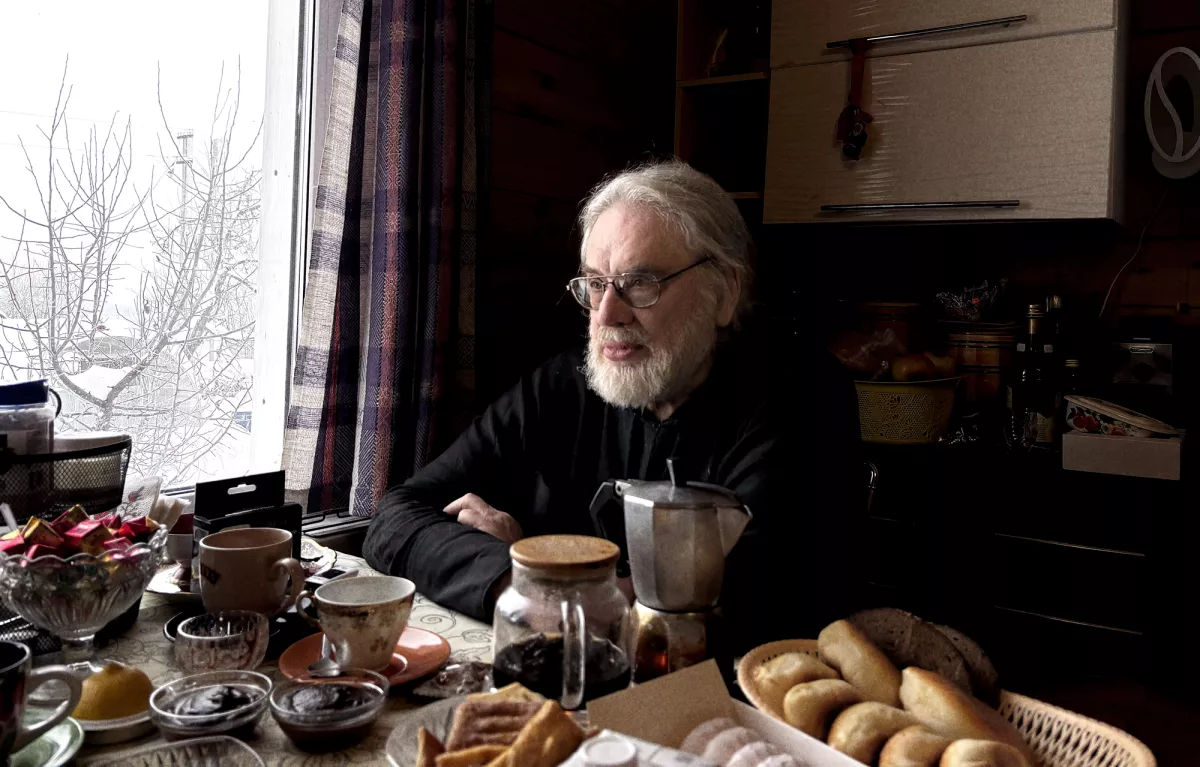
“I remember meeting students near the synagogue whom I had studied with,” he recalls. “They would step aside from me, even though we had been friends at the institute. Later, they left. I think that if someone had said to me then, ‘Come with us,’ I would have gone without hesitation.”
But no one ever said that to him, and now his conversion to Orthodox Christianity is an obstacle to obtaining Israeli citizenship: by changing religion, a Jew loses the right to repatriate. “It doesn’t let go of me,” he says. “Because in truth, I do not feel like a citizen of this country. Nothing ties me to this place.”
Gregory Markus Severin Winter
Until 2020, Gregory Markus Severin Winter was Grigory Elektronovich Winter. His father is the well-known professor and Doctor of Philology, Elektron Dementyev.
Gregory’s older brother inherited everything from their father at once: his surname, patronymic, and given name. His name is Elektron Elektronovich. Grigory, however, bore his mother’s surname from birth, because “father had many children and wives, and my mother wanted the surname to survive.” He speaks often and warmly of his mother, but of his father with resentment. He lived with his parents until their deaths.
“Because of the harassment and persecution, my father began to lose his mind,” Winter says. “Living with someone who is half out of his mind is very difficult. There were daily hysterics about people holding him back and not letting him work.”
Gregory lived with his parents and brother in Vladivostok, and in 1981 they moved to Cherepovets because, as he puts it, “my father was accused of being a dissident, forced to resign from the Far Eastern Institute of Arts, where he had worked in recent years, and told to leave Vladivostok on a ‘voluntarily-mandatory’ basis.” Winter is convinced that his father was persecuted for appealing to the Soviet authorities against the war in Afghanistan. The move was hard on him: “Cherepovets was a dump: small wooden houses, terrible environmental issues, lots of factories, half the city were former convicts, and there were sixteen commandant’s offices for the penal laborers,” he says.
A close relative, who resides in Vladivostok and lived with them for a while in the past, and who asked OVD-Info to remain anonymous, has a different opinion on the reasons for the move: “University lecturers and professors went there to rebuild the Far East, since the entire professoriate had been executed there in the 1930s,” he says. “They [Gregory’s parents] were among them. Vladivostok is tens of thousands of kilometres away from the centre of the country; close relatives are far away, and it costs a lot of money to fly to visit grandma in St. Petersburg. They decided they had fulfilled their duty to the Far East, and since the residence registration system was still in place at that time and moving to the capitals was difficult, they had to choose Cherepovets. It turned out to be equidistant from Leningrad and Moscow.”
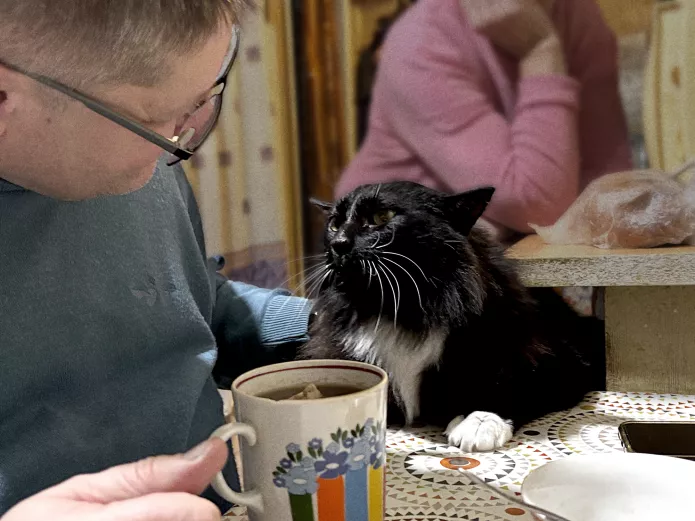
Like his parents, Winter taught at university and private schools, and because he was tight with money, he also worked at an orphanage. Winter inherited his love for animals from his mother, who often brought stray cats home. Gregory continued to do the same after he was on his own.
In 2020, when he “got sick of his Russified name,” Winter changed both his first and patronymic names. By the way, his mother “had always wanted [the name] to be ethnic.”
“During my arrest (in 2020 under the ‘fake news’ law regarding the coronavirus, when Winter was kept a month in the Cherepovets pretrial detention center—OVD-Info), I was brutally beaten because of the assumption that I am not Russian. So I decided: since I’m not Russian, here you go! Severin is my six-times-great-grandfather, who moved his family from Königsberg to Vyborg; Markus is his brother, whose body was buried in the wall of the Königsberg cathedral.”
Baptism
“We have lived in such an environment where nobody really cared about the faith. Then freedom came, and many people in our circle left the church. Because before, the church was a gulp of freedom in an oppressive world. And then that gulp vanished. A persecuted church and a conformist church are two different things,” says Father Alexander.
He and his wife, Mother Nadezhda, moved to the Ivanovo Region in 1995. Alexander learned how to operate a tractor, plow the land, sow seeds, and plant potatoes. In 2008, he was sent to [the village of] Strelka as a priest. At that time, Father Alexander began working with prisoners in the Ivanovo Region. He travelled to women’s and men’s prisons and visited detention centers. He heard confessions and administered Holy Communion.
“We had a priest who fainted during confession in the prison camp and stopped going there. I’ve never fainted. In fact, the only truly repentant people I ever met were there, behind the barbed wire. I have only had one instance where a man didn’t trust me and was afraid to confess.”
The priest says that ministry in women’s and men’s prisons differs: he feels “insane pity” for the women, since many are serving time for cases of self-defence, for killing an abusive husband or partner. “It’s a recurring refrain: ‘He attacked me, so I hit him with a frying pan or a knife,’ ‘He beat me and abused me, so in the end I hit him,’ ‘I was defending my daughter when my husband was abusing her.’”
Another group of women, he says, have been convicted under drug laws: “They turned users into dealers—young girls who were supposed to serve three-year sentences ended up getting ten [years in prison].”
“Unwritten rules still govern life in the men’s colony,” explains the priest. “If it’s ‘black [colony],’ then it’s ‘black.’ There are castes. In the women’s prison, there’s none of that, and on the one hand, that makes it harder because the administration decides everything; on the other hand, at least in the Ivanovo prison, the colony staff weren’t monsters. Although there were separate ‘family’ units—sometimes some women were sent there by force, and if a woman isn’t ready for that, it’s a tragedy.”
According to him, one particular challenge is dealing with the caste of “untouchables” or “outcasts.” Under prisoners' rules, any contact with them is strictly prohibited for other inmates, which can lead to conflicts during communion or when kissing the cross or an icon. A prison chaplain must be aware of this issue and find ways to resolve it.
While we discuss prison caste systems and homophobia (on this issue, Father Alexander’s views largely align with the official rhetoric of the Russian Orthodox Church and he talks about the “gay lobby”), Winter paces impatiently around the room: Gregory never went to church while in prison; he knows nothing about how the ceremony will proceed or what to prepare for. He urges us on, and we head to the church.
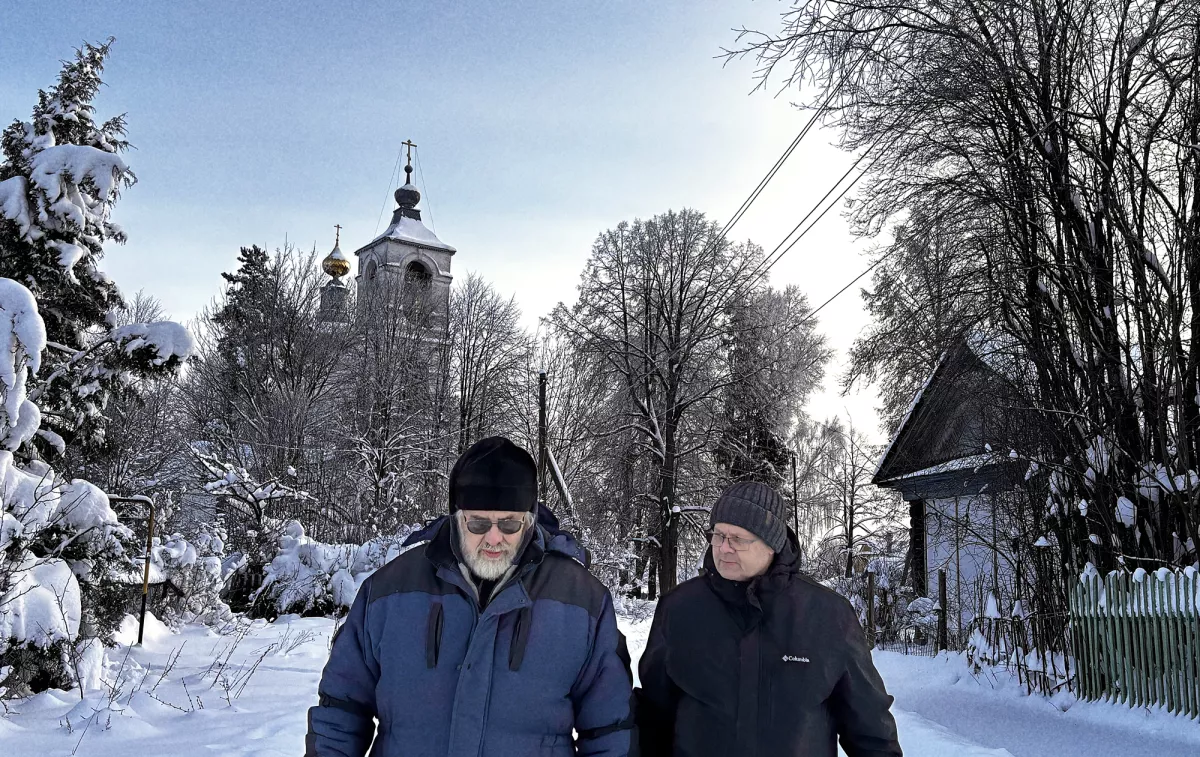
It’s freezing both outside and inside the church. The ceilings are very high. Old frescoes have survived in places under the vault. Winter doesn’t have a cross with him, so the priest gives him his own. The church smells faintly of incense. Father Alexander asks everyone to leave him alone with Winter for a little while. Confession begins. The priest’s wife brings water, lights candles by the font, and goes back home. There’s a well near the church, but it’s not functional. For the water that will be blessed during tomorrow’s service, people go to Tatiana; her little hut is a couple of minutes’ walk from the church.
Awkwardly clasping his hands, Winter stands facing the chalice. He’s still in a t-shirt; he doesn’t have a baptismal shirt either. Father Alexander stands in front of him, turns his back to Winter, and begins to read prayers softly; the Church Slavonic words fall from his mouth one after another, needing no reply.
“O Lord Sabaoth, God of Israel, who healest every sickness and every wound, look down upon Thy servant; seek him out, examine him, and drive away from him every working of the devil…”
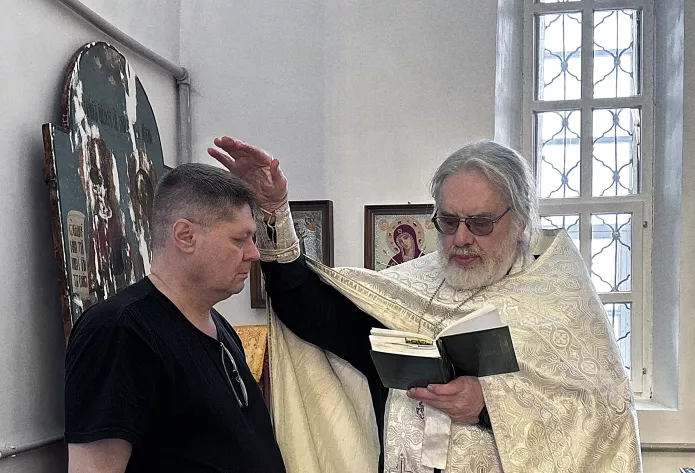
Then the questions begin. Does he renounce evil? Does he unite himself with Christ? Before the priest pours water over him, Gregory rolls up his trousers, takes off his t-shirt, and looks even more vulnerable, especially in the cold of the church. The font, a simple metal basin, is already filled with water.
That evening, as we walk along the church toward Tatiana’s little hut, where we’re staying the night, Winter, remembering the moments after the baptism, compares the ritual to gaining freedom:
“When I walked out of the church, it felt like I was walking out of prison. Turns out the air in there and the air out here is different, even though there’s only a fence between the two of them.”
“I wouldn’t have written it now”
“[After getting out of the penal colony] it’s really strange to me that the gadgets didn’t work,” Winter says, looking at his phone screen. “I don’t understand how to use a VPN. People seem kind of down. My relatives who moved abroad have cut me off, even though we were in touch before the arrest. I tried to reach them, but they aren’t replying to my messages.”
Winter was tried over four posts about the strike at the Mariupol Drama Theatre and a comment about events during the occupation of Irpin and Bucha. He says that he wouldn’t have written a comment like that now and that he’s “angry at Ukrainian propaganda,” especially at the former Ukrainian ombudswoman, Lyudmyla Denisova, whose claims about raped children were not confirmed.
“I stopped posting anything about it from the second half of March 2022, ” he says.
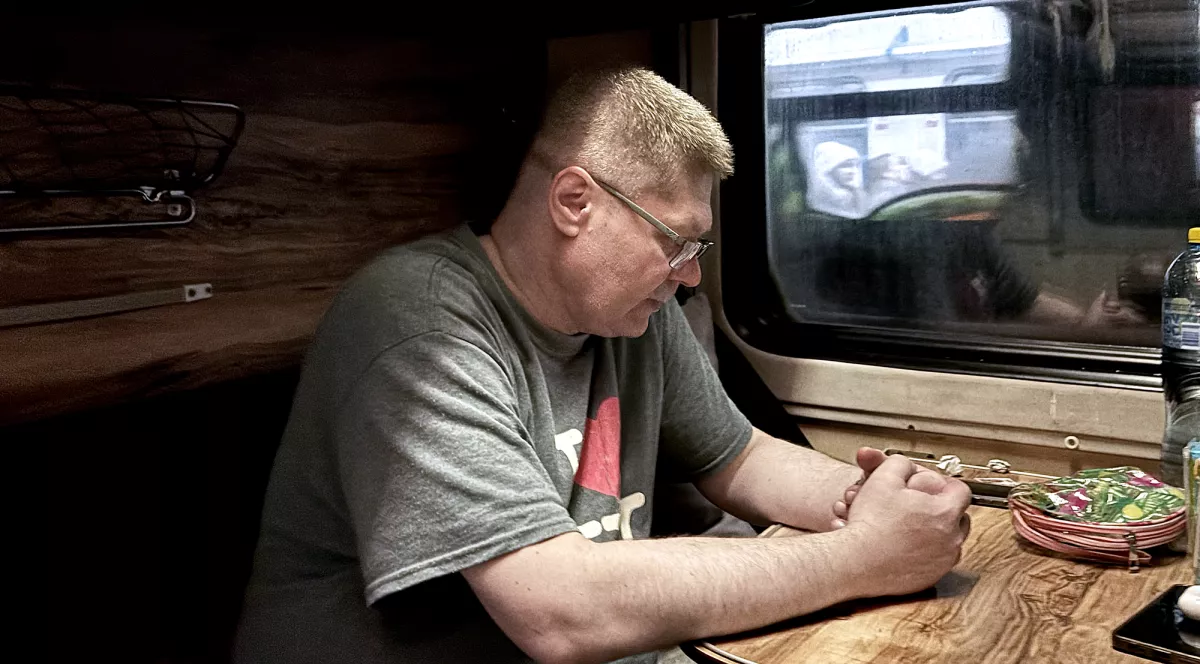
We head back. We walk to Kamenka. We take a bus to the station in Vichuga, the local district centre. The town is in shutdown, and mobile internet isn’t working. The station feels bleak, dark, and cold. A group of girls and boys gathers there too; they’re also waiting for the night train to Moscow. I ask them what’s going on with the connection, and the boldest one answers, “It’s because of the drones.”
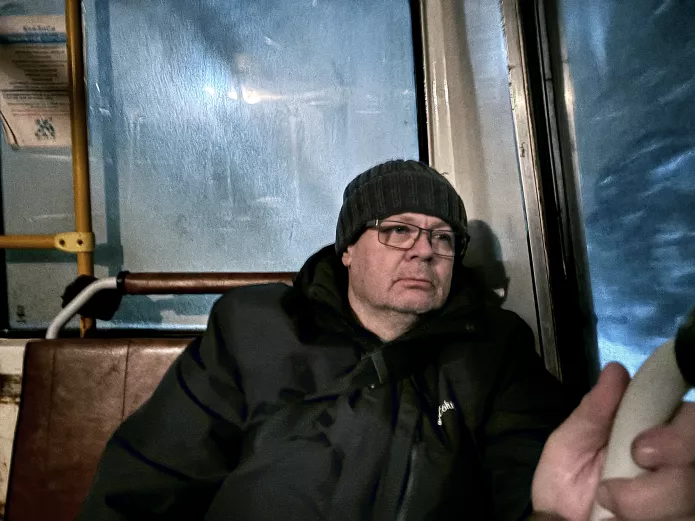
In Moscow, we get off at Yaroslavsky Station to a loudspeaker announcement: “Dear participants of the special military operation, we thank you for your heroism…” Gregory stops and says that after two years under arrest, he’s grown unaccustomed to this context and to the constant mention of the “special operation.”
When the conversation turns to the war, Winter unexpectedly says things that are hard to reconcile with the criminal case and the months in isolation for an anti-war post. He believes Vladimir Putin realised he “made a mistake,” and so he is “purging the state apparatus of corrupt officials and fraudsters.”
“The guys I was locked up with met Putin at the front line and said he wants to end the war on Russia’s terms, because the new territories were paid for with the blood of people who died. I’m a pacifist, and I can’t justify any military campaign anywhere, but unfortunately, the situation isn’t at all what it was at the beginning,” he says.
A few minutes later, a handsome dark-haired young man in a light grey jacket approaches us, wearing shoes on his bare feet despite the cold. It’s Khayal, Gregory’s adopted son. Khayal still isn’t used to the Moscow winter. He and Winter hug tightly.
In Gregory’s retelling, the story of how he gained a son sounds almost like a New Year’s fairy tale. According to him, Winter found his son in the snow.
One winter day in 2006, he was walking home and noticed a boy sitting in a snowdrift in the courtyard. Gregory bent down to the child and asked where he lived. The boy silently pointed to the first-floor windows. They walked together to an entrance without an intercom, went inside, and entered an apartment—the door wasn’t locked.
“A short, very swarthy man came out to meet us,” Winter recalls. “He didn’t even ask who I was or why I was bringing his child. He immediately offered tea.”
The kitchen, Gregory says, was poor but clean. Khayal climbed onto his lap and started studying his face. It turned out that the three-year-old’s father had recently been released from a penal colony, where he’d served time for murder. Khayal’s mother had left the family.
Winter began visiting them, bringing fruits for the boy. Soon, Khayal’s father told him they had to move out: their apartment belonged to a man who had been in prison with him and was planning to return there upon his release.
“I went to my mother and said: I want to take the child in, but right now he is living with his father and they have nowhere to go. My mother’s response was concise: ‘If you think it’s necessary, I’m not against it.’ Even before meeting Khayal, we had discussed that I wanted to adopt a child from an orphanage.”
The father and son moved in with them. Edik (as Winter calls Khayal’s father) began helping around the house: he cleaned up after the numerous cats and gave injections to Gregory’s mother. But soon, according to Winter, the peaceful picture fell apart: Edik disappeared, leaving the child behind. Gregory and his mother were left alone with the boy. Having previously worked in an orphanage, Winter understood that keeping someone else’s child without documents was risky and illegal, so he contacted the police. Khayal was taken to an orphanage, where he spent the entire summer. Gregory visited him almost every day while simultaneously applying for “guest family” status.
When Khayal began living with them again. Edik returned and agreed to let Gregory file for legal guardianship—on paper, the man wasn’t even registered as the father; the space on the birth certificate had been left blank.
Winter describes the following events as a “thriller with elements of horror.” The paperwork began, but the process moved slowly, bogged down by bureaucratic red tape. Eventually, social service officers arrived and announced that the child’s term in the “guest family” had expired. Khayal was taken back to an orphanage, where he lived for nearly six months before being placed in a social rehabilitation center in the village of Ilyinskoye.
Sometime later, Gregory received a call from the police: Edik had been arrested on suspicion of robbing and murdering an elderly woman. Winter began searching for a lawyer for him, while Khayal was taken away again—this time to an orphanage over two hundred kilometers from Cherepovets. Gregory only managed to track him down seven months later. The boy spent several years in that orphanage. During this time, Winter was fired from the university—according to him, the vice-rector stated they were “fed up with his eighteen months of calls from investigators.” Despite this, he managed to find Khayal’s grandparents in Azerbaijan.
The father [of Khayal] hadn’t spoken to his relatives in twenty years, and then some guy named Winter calls Azerbaijan and says “Hello, I’m an acquaintance of your son, I’ve been raising your grandson.” They said: “What grandson? What son? Come on, stop making things up.” Nevertheless, the relatives came to meet the child, The guardianship process took another two years, and at age ten, Khayal was sent to Azerbaijan.
Winter says his path as a human rights activist began with this story: “Human rights advocacy didn’t just enter my life, it broke into it.”
While Gregory was in the penal colony, Khayal was detained. That same day, November 16, a court in Baku ordered his deportation to Russia—after thirteen years living in Azerbaijan, the young man had never managed to obtain local citizenship. He now lives in Moscow, where we return after our journey to see the priest.
Khayal has a strong accent. He says that “Uncle Grisha” has changed a great deal: “When I saw him [the last time], he was young, and now he’s aged. Honestly, I barely remember anything about my childhood. I can’t call anyone ‘father,’ but there’s something about this man that feels like a family to me. And his mother loved me very much, she was like a grandmother to me.”
Until January 18, 2024, when the Cherepovets City Court sentenced Winter to three years in a penal colony, there was time to try to leave the country. I ask Gregory if he ever considered it—he looks back at me with something close to contempt.
“Leave, why? If I leave and never come back to this country, I will lose everything—my property, my paleontological collections, my parents’ collection of antique books. And then what, live like a homeless person in Europe? I don’t know the language and probably never will. I’d spend the rest of my life surviving on welfare in a foreign country, with nothing of my own.”
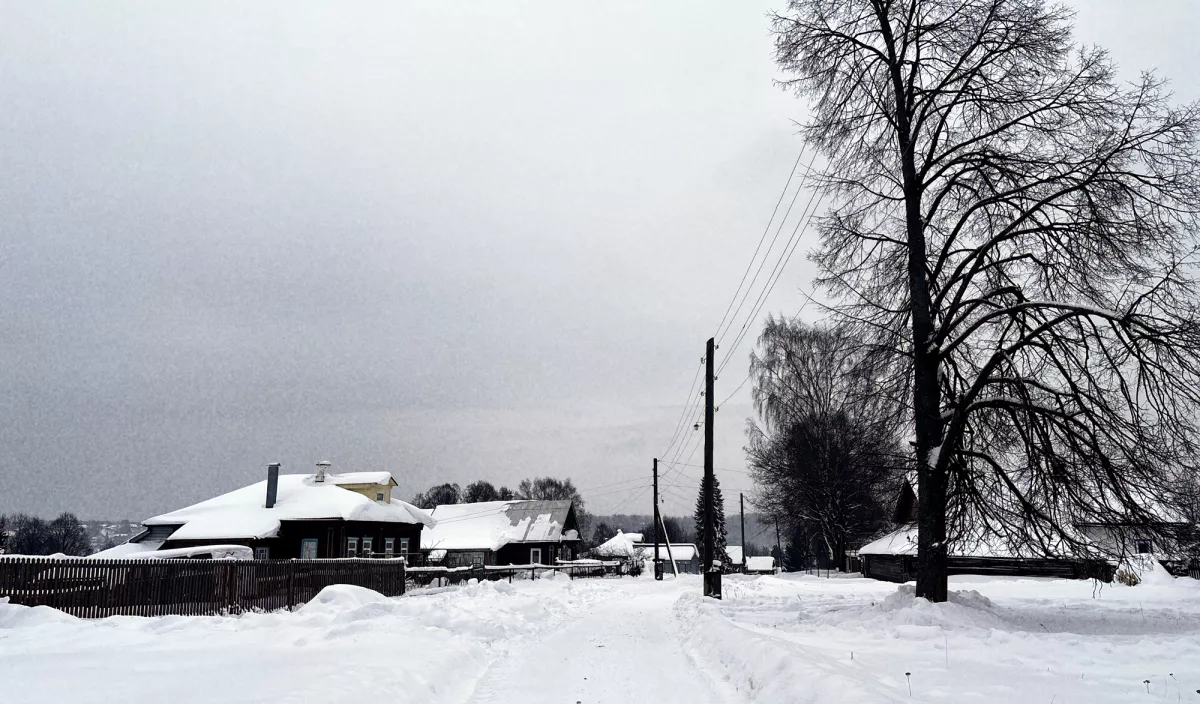
After saying goodbye to Khayal and I, Gregory returns to Cherepovets. Winter recounts that before his arrest, he had asked an acquaintance to stop by his apartment—just to check if everything was alright. But when Gregory came back from the penal colony, he found the windows open, the pipes clogged, the plants gone, the rooms cold and in disarray. Curtains and cat litter boxes had been pulled onto the floor, furniture was piled in a heap in the middle of the room, and on top of it sat clumps of soil from the flower pots. On his first night home, Winter spends his time trying to get the sewage system working again.
Marina-Maya Govzman
NO ONE WILL EVER KNOW
Unless someone writes about it. OVD-Info is often the sole source for news on repression, while also providing legal aid to political prisoners. We depend entirely on your support to continue. Join our recurring donors to keep these stories—and people—from being forgotten.