 Search


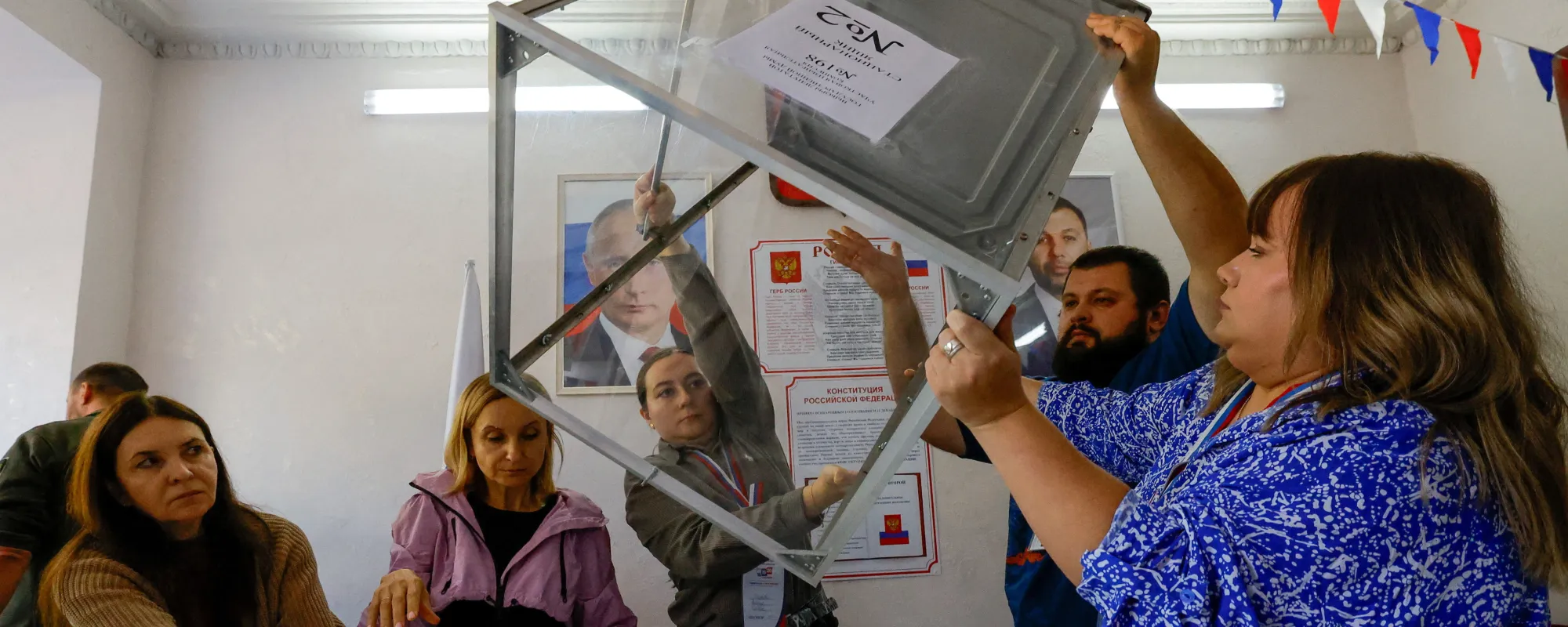
From September 18 to 20, Russia held elections for the State Duma and regional parliaments, as well as for the heads of several federal regions. According to official data, turnout was the highest in many years. However, hundreds of election observers were denied access to polling stations or faced restrictions on their work. Some of them were detained. Candidates were also detained and intimidated. On all three days, polling stations in Moscow refused to issue paper ballots. Here is OVD-Info’s summary of the most important developments from the three days of voting.
NO ONE WILL EVER KNOW
Unless someone writes about it. OVD-Info is often the sole source for news on repression, while also providing legal aid to political prisoners. We depend entirely on your support to continue. Join our recurring donors to keep these stories—and people—from being forgotten.
For all three days of voting, OVD-Info monitored pressure on voters, election observers and candidates. We also used open data from the Elections 2026 project in our analysis.
Pressure during the election was merely the final stage of a much longer process.
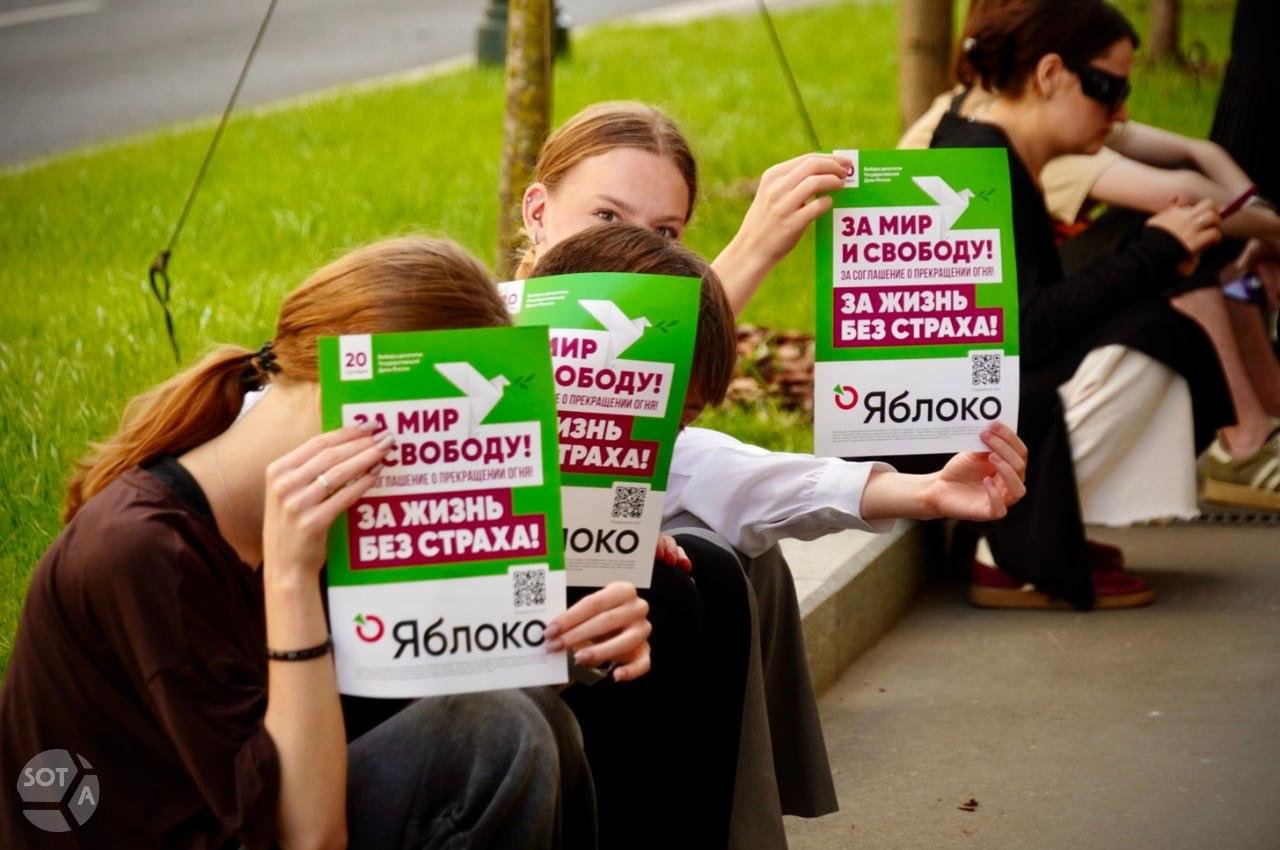
The main story was the removal of candidates from the race. This was mostly achieved through lawsuits brought by spoiler candidates from the Greens, the Pensioners’ Party, the Communists of Russia and the Liberal Democratic Party of Russia (LDPR). In the Chelyabinsk Region, all five Yabloko candidates for the State Duma were removed from ballot on various pretexts, including far-fetched copyright claims over the work of Banksy and a quote by Andrei Sakharov.
At the same time, candidates were fined and arrested over old social media posts featuring the logos of banned social networks, under legislation prohibiting the display of “extremist” symbols. Such a conviction automatically bars someone from standing for election for a year.
Yabloko, the only anti-war party, was initially registered for the election but later removed due to a lawsuit filed by the pro-Kremlin party Rodina.
Territorial Election Commissions (TECs) refused to accept lists of observers: commissions were closed during working hours, signatures ‘went missing,’ and documents were rejected for technical reasons (because they were provided on a disc instead of a flash drive, for example) or over other minor formalities, with no opportunity to correct them. In Chuvashia, observers were offered money in exchange for not showing up. In Bashkortostan, the Communist Party of the Russian Federation (CPRF) proactively withdrew 24 observers from the Ufa city council election over alleged affiliation with ‘foreign agents’ and the ‘non-systemic opposition.’
According to the CPRF, at least 1,175 party observers were barred from monitoring the election. The publication 7×7 counted around 1,300 observers from the CPRF and Yabloko who were not allowed to participate.
Support OVD-Info! We’re still working to defend human rights in Russia, but only people living abroad can safely support our efforts. Donate today using a foreign bank card or cryptocurrency.
Analysis of Administrative Pressure
Based on combined data from OVD-Info and the Elections 2026 project, we recorded a total of 590 reports of administrative pressure, including 409 during the voting period. OVD-Info also recorded 18 reported arrests.
331 (56.1%) violations involved preventing people from exercising their right to vote (being denied entry to a polling station, removed from one, etc.), 130 (22.0%) involved pressure linked to dependency (through an employer, educational institution, etc.), and 119 (20.2%) involved coercion to vote. 34 (5.8%) reports concerned some form of physical violence.
Reports of voter coercion came mostly on 18 September, the first day of voting. Some employers required their workers to vote specifically on that day.
The data shows a consistent pattern: the voting date was strictly fixed, often down to the hour; a particular voting method was imposed; and employees were required to provide proof that they voted, in the form of a screenshot, a photograph from the polling station, their geolocation, polling station number, or through a call from their supervisor.
Pressure to participate in the election also extended to family members. Staff members at Moscow’s Genplan Institute were asked in advance for the names of relatives who planned to vote online, and everyone was required to submit screenshots on the first day of voting. Teachers in Yakutsk reported their students’ parents’ turnout every two hours.
The practice affected schools, universities, municipal facilities, utility companies and factories, and, in the Belgorod Region, even the treasury and the Justice Ministry’s regional office.
Gradually, the focus of the pressure shifted from voters to election observers, and from administrative pressure to police and court action.
The legal tactics previously used against candidates were turned against observers and election commission members: the number of reports of documented persecution rose from 9 on the first day to 23 on the third. The same pattern repeated across different regions: an observer representing the Public Chamber would draw up a report alleging a violation, a commission would file a lawsuit, and a court would uphold it. In the Moscow Region, observers were removed from polling stations in Shchyolkovo, Dolgoprudny and Mytishchi, while members of commissions No. 357, 367, 1667, 1684 and 1699 were suspended. In St Petersburg, there were more than a dozen documented suspensions based on district court rulings.
36 reports involved video recording as a source of conflict. Observers were banned from filming, their positions were cordoned off with tape to restrict their movement, they were asked to provide press accreditation, their equipment was confiscated, and official reports were drawn up against them.
During the vote count, the ban on recording was followed by requirements to maintain a physical distance. In Krasnodar, observers were supposed to stay ten metres away from the ballots; in Perm, they were ordered to remain 30–50 metres away.
Access to surveillance footage was denied to the Communist Party’s regional committee in Lipetsk, Yabloko and A Just Russia candidates in St Petersburg, the Communist Party in the Perm Region, and commission members in Goryachy Klyuch. In Tobolsk, by contrast, a video recording was used as a tool of pressure, with an observer threatened with prosecution and removal from the polling station.
Pressure to Use Electronic Voting in Moscow
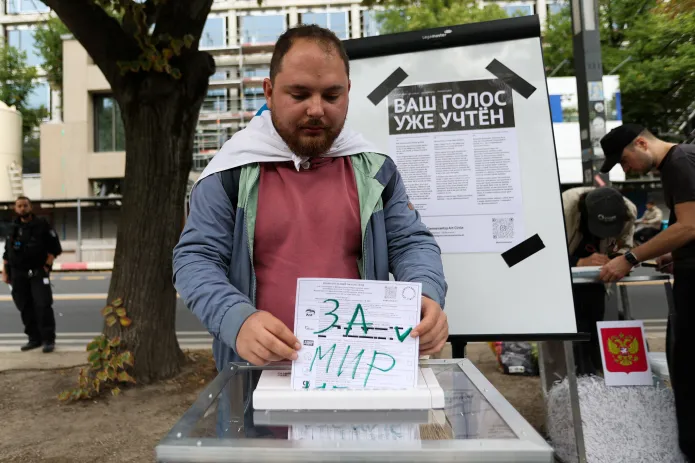
Reports of problems with paper voting came from many Moscow polling stations throughout all three days: lines formed, systems froze, and paper ballots were not issued, while voters were offered the option of using electronic voting terminals (EVTs) instead. The number of such reports peaked on September 20.
There was a clear trend of steering voters towards EVTs. At the entrances to polling stations, commission members asked voters to tap their passports against a terminal without explaining that this would register them for electronic voting, after which they were denied paper ballots. There were also reports of physical ballots allegedly ‘running out,’ software failures, and voters being refused paper ballots because they were not registered as Moscow residents.
Around 20 such cases were recorded in total.
At one polling station, voters were told that they had all been ‘automatically registered’ for electronic voting. The Moscow City Electoral Commission attributed the system failures to cyberattacks, and polling stations later resumed issuing paper ballots. Dmitry Reut, deputy head of the Moscow City Electoral Commission, said that asking for a paper ballot after receiving an electronic one amounted to an attempt to vote twice, which constitutes a criminal offence.
The publication Important Stories described remote voting as a ‘black box.’ The journalists also found that the state’s new automated elections system can accept the results of Moscow’s electronic voting even when the digital signature on the file has not been verified. In other words, the system makes large-scale electoral fraud more possible while making verification more difficult.
At the same time, a lawyer who works with OVD-Info points out that electronic voting is a right, not an obligation.
‘In general, government mechanisms for interfering in the electoral process are becoming increasingly sophisticated: instead of blatant violations, administrative procedures and technological solutions are more frequently used that formally appear legal, yet in practice can severely restrict the ability to exercise voting rights,’ the lawyer said.
Detentions and Violence
OVD-Info recorded 18 detentions in total. Four people were detained in Moscow, three in St Petersburg and three in Izhevsk. Detentions were also reported in Ufa, Novosibirsk, Rostov-on-Don, Perm, Chelyabinsk and Novorossiysk. Four people were sent to special detention centres.
Those detained included three candidates, six election observers and one member of a territorial election commission with voting rights. Two people were beaten during their detention. At polling station No. 1919 in St Petersburg, an observer was denied entry after an election official claimed he wasn’t registered to monitor the vote. A police officer who was called to the scene threw the observer to the ground and pinned him down, knocking him unconscious. The observer was then taken to a police station and fined for disobeying the police.
Dzhemali Gogoli, a member of the territorial election commission representing the Communist Party, was jailed for ten days in Novorossiysk in connection with a two-year-old criminal case, after observers at local polling stations reported non-functioning cameras and ballots being issued without signatures.
Blogger Rada Russkikh, who attempted to run for president as an independent candidate in 2024, spent a day in detention in St Petersburg; after being released, Russikikh said she had been beaten while in custody. In Chelyabinsk, Yabloko supporter Vladimir Yuzhakov was detained for tagging the pavement outside polling stations with the slogans ‘Make love not war’ and ‘Peace to the world! ’ At the police station, officers tried to write in their statement that Yuzhakov had written the slogan ‘No to War,’ a phrase used as grounds for prosecution for ‘discrediting’ the military, and threatened to deprive him of citizenship.
A car followed Bair Tsyrenov, a Communist Party candidate in Buryatia, while observers from the same party in the region had their tyres slashed. In Tatarstan, candidate Irina Nikiforova’s team withdrew its observers after receiving threats.
Members of election commissions in St Petersburg and observers in Moscow received military summonses requiring them to report to recruitment offices on voting days. The campaign headquarters of Communist Party candidates in the Altai Region and Khakassia reported receiving large numbers of anonymous calls.
As the lawyer working with OVD-Info notes, a contradiction can be seen in the way these elections were conducted: ‘On the one hand, the authorities create formal opportunities to take part in the elections—for example, voters could choose in advance to vote in another region if they live somewhere other than their registered address, or even vote remotely. On the other hand, in practice, voters’ ability to choose a convenient voting method was restricted: in Moscow, the issuing of paper ballots was obstructed, and independent candidates were barred en masse. As a result, the formal possibility of voting remains, but opportunities to freely choose how and for whom to vote are consistently shrinking.’
The OVD-Info editorial team
NO ONE WILL EVER KNOW
Unless someone writes about it. OVD-Info is often the sole source for news on repression, while also providing legal aid to political prisoners. We depend entirely on your support to continue. Join our recurring donors to keep these stories—and people—from being forgotten.